

Last Updated: November 2, 2026
Quick Summary
The best surf booties for cold water trap a warm layer against your skin while still letting you feel your board, so match thickness to your actual sea temperature rather than the air. Choose 3 mm for 13-16°C, 5 mm for 9-12°C and 5-7 mm below 9°C, and check the ankle seal first if your feet go numb.
- A thick boot with a poor ankle seal flushes on every duck dive and ends up colder than a thinner boot that fits.
- Pair a 3/2 wetsuit with 3 mm booties and a 5/4 or thicker suit with 5 mm booties.
- Split-toe boots give better board feel and balance, while round-toe boots are warmer with fewer seams to leak.
- Rinse booties in fresh water inside and out after every session and dry them in the shade, away from direct heat.
- Never use hot water on numb feet; warm them gradually with dry towels and warm, not hot, water.
Table of Contents
- How Cold Water Changes What You Need From Surf Booties
- How to Choose Wetsuit Boots by Water Temperature
- 3 mm vs 5 mm Surf Booties: Matching Thickness to Your Wetsuit
- Split-Toe Surf Boots vs Round-Toe: Which Design Suits You
- Your Surf Booties Size Guide: Fit, Sizing and Avoiding Gaps
- Sole Thickness, Grip and Board Feel: Finding the Balance
- Diagnosing Cold or Numb Feet (and What to Do About It)
- Care, Drying and Making Your Booties Last
- Frequently Asked Questions
How Cold Water Changes What You Need From Surf Booties
Cold water pulls heat out of your feet far faster than air does, so the best surf booties for cold water are the ones that trap a warm layer against your skin while still letting you feel your board.
Here's the thing most guides get wrong. They treat thickness as the only variable. It isn't. A thick boot with a poor seal flushes cold water on every duck dive and ends up colder than a thinner boot that fits properly.
So before you shop, understand three things: how cold your local water actually gets, how well the boot seals at the ankle, and how much board feel you're willing to give up. For a curated collection of cold-water gear, browse our Cold Water Necessities. Get those right and the rest is detail.
Met Office coastal sea temperature data
How to Choose Wetsuit Boots by Water Temperature
Match boot thickness to the water you actually surf in, not the air temperature on the beach. A sunny January day with sea temps in single figures still demands proper insulation, and a cloudy August session usually doesn't. The chart below gives a starting point in Celsius, accounting for more than a simple rule of thumb.
A Simple Temperature-to-Thickness Guide in Celsius
| Water Temperature | Boot Thickness | Typical Session | Notes |
|---|---|---|---|
| 17°C+ | Thin (1-2 mm) or none | Summer, short sessions | Overheating is the bigger risk; thin soles still help on shingle |
| 13-16°C | 3 mm | Spring and autumn | Most versatile single pair for year-round surfers |
| 9-12°C | 5 mm | Winter, longer sessions | Add a thermal lining if you run cold |
| Below 9°C | 5-7 mm | Deep winter, dawn patrols | 7 mm only if you feel the cold badly or surf long sessions |
Treat the chart as a starting point and adjust from there. Three things move you up or down a row:
- Wind chill and air temperature. A 10°C sea with a biting offshore wind feels colder than a still 10°C day, because wind strips heat from exposed skin and speeds up heat loss through the neoprene. If the forecast is windy, err towards the thicker boot.
- Session length. A 45-minute smash-and-grab in 11°C water is fine in 5 mm; a three-hour session in the same water will chill you through if the boot is thin or flushing. Longer sessions reward thickness and a better seal more than short ones.
- Your own circulation. Some surfers run cold in their hands and feet regardless of the water. If that's you, size up in thickness rather than down, and prioritise a boot with a thermal lining over a plain neoprene build.
A common pattern is that surfers buy one pair of 3 mm boots for everything and then wonder why January feels miserable. If you surf year-round in Britain, two pairs, a 3 mm for spring and autumn and a 5 mm for winter, will keep you warmer than one compromise pair. If you only surf the colder half of the year, go straight to 5 mm and add a thermal lining.
Met Office coastal sea temperature data
3 mm vs 5 mm Surf Booties: Matching Thickness to Your Wetsuit
Your booties should roughly match your wetsuit, because a cold extremity ruins an otherwise warm suit. If you're in a 5/4 winter suit, a 3 mm bootie leaves a gap in your defences. If you're in a 3/2 summer suit, a 5 mm boot can feel like overkill.
The pairing that works for most people:
- 3/2 wetsuit → 3 mm booties
- 4/3 wetsuit → 3 mm or 5 mm depending on water temp
- 5/4 or thicker → 5 mm booties
When 5 mm Surf Booties Are the Right Call
Reach for 5 mm when the water is genuinely cold, when you're surfing for more than an hour, or when your feet are the first thing to go. Our Sisstr 5mm Closed Toe bootie pairs a full thermal lining with 100% Super Stretch neoprene, so it insulates heat and dries fast. The trade-off is board feel: thicker neoprene dulls the connection underfoot, which matters more for technical surfing than for cruising.

Split-Toe Surf Boots vs Round-Toe: Which Design Suits You
Split-toe surf boots separate your big toe from the rest, which gives a more natural grip on the board and better balance through turns. Round-toe boots keep all your toes together, which is warmer because there's less surface area and fewer seams to leak.
Choose split-toe if board feel and control matter most to you. If you want to act on the split-toe side, our Sisstr 3mm Split Toe bootie gives you toe separation in a 3 mm build.

RNLI cold water safety guidance
Sisstr 5mm Closed Toe bootie →
Your Surf Booties Size Guide: Fit, Sizing and Avoiding Gaps
A surf booties size guide comes down to one test: the boot should feel snug everywhere with no pinching and no dead space at the toes or heel.
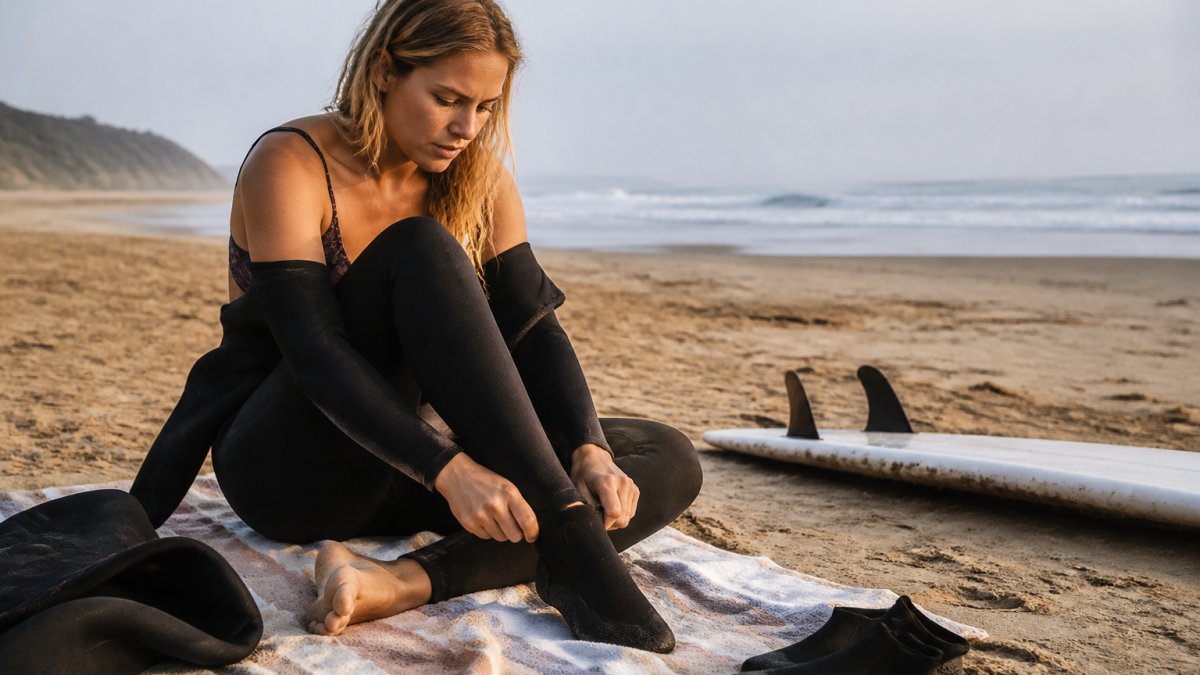
Try booties on with your wetsuit if you can, and walk around. For deeper guidance on wetsuit sizing for different body shapes, read The Curvy Woman's Guide to Wetsuit Sizing.
Sole Thickness, Grip and Board Feel: Finding the Balance
Thicker soles protect your feet from reef, rock and cold sand, but they cost you board feel. Thin soles keep you connected to the board but offer less protection on a rocky shore.
Think about where you actually surf. Long walks over shingle and reef demand more protection; a quick paddle out from a sandy beach doesn't. Most surfers land on a medium sole as the sensible compromise. Grip matters too: a textured sole helps on wet rocks and slippy car parks as much as it does on the board.
Diagnosing Cold or Numb Feet (and What to Do About It)
Numb feet mid-session are usually a symptom, not a mystery. Work through the likely causes in order, because the fix is different for each one.
1. Check the seal at the ankle first
A loose cuff is the most common culprit. Every duck dive and every wave you ride pushes water through the boot; if the ankle isn't flush against your wetsuit, that water is replaced constantly and your body never gets to warm the thin layer neoprene is designed to hold. Look for a gap between the boot cuff and the suit leg, or a cuff that rides up when you paddle. A boot that fits snugly at the ankle but has room at the toes will still flush.
2. Check thickness against the temperature chart
If the seal is good and your feet still go, you're probably under-insulated for the water and the session length. Go back to the Celsius chart above and compare your boot to the band you're actually surfing in. A 3 mm boot in 9°C water is a common mistake, it's fine for a quick session on a mild day, but not for two hours in February.
3. Consider circulation and session length
When your core temperature drops, your body prioritises your vital organs and restricts blood flow to your extremities. That's why your feet can go numb even in a boot that's warm enough on paper: you've been out long enough that your body is making a decision for you. The fix isn't a thicker boot, it's getting out sooner, warming up gradually, and not pushing a session past the point where your body is clearly struggling.
When numbness should end your session
Mild cold feet are normal. Numbness that persists after you're out of the water, pins and needles, or skin that looks white or waxy are signs to stop, get warm and stay warm.
A useful habit is to note the water temperature, your boot thickness and how long you lasted before your feet went. After a few sessions you'll see your own pattern, and you can adjust thickness or session length before the numbness happens rather than after.
Care, Drying and Making Your Booties Last
Rinse your booties in fresh water after every session, inside and out, to clear salt and sand. Dry them in the shade, away from direct heat. Turn them inside out to dry the lining, then flip them back.
Watch out: stuffing wet booties into a bag and leaving them in a warm car is how you get permanent odour. Air them fully between sessions. If you're weighing up whether pricier gear is worth it, read Is Expensive Surf Gear Worth the Money?.
Frequently Asked Questions
What thickness surf booties do I need for cold water?
It depends on the water temperature you're surfing in. As a general guide, 3 mm surf booties suit milder conditions where the water stays above roughly 15°C, while 5 mm booties are the better pick for colder sessions where the water drops below that. Match your boot thickness to your wetsuit thickness too, so your feet aren't the weak point in an otherwise warm setup. If you're regularly surfing through winter, a 5 mm pair gives you more thermal insulation for longer sessions.
Are split-toe or round-toe surf boots better?
Neither is universally better, it comes down to what you want from your session. Split-toe surf boots separate your big toe from the rest, which gives more natural movement and better board feel, so they suit surfers who prioritise control and responsiveness. Round-toe or closed-toe booties keep more warmth in because there's less surface area for cold water to flush through, making them the warmer option for very cold conditions. Many surfers keep a split-toe pair for milder days and a closed-toe pair for winter.
Should surf booties fit tightly?
They should fit snugly, but not so tight that they restrict circulation or feel uncomfortable. Excess space is the real problem: gaps let water pool inside, which defeats the insulation and leaves your feet cold. Follow a surf booties size guide and check that your toes aren't curled and your heel isn't sliding. If you're between sizes, think about the wetsuit you'll wear them with and how thick your neoprene socks might be, since that changes the fit.
How can I stop water getting into my surf booties?
Most water entry happens at the ankle cuff. Check that the cuff sits flush against your wetsuit leg and that any closure is done up properly, since a loose seal lets water flush in with every duck dive. Wearing your wetsuit leg over the bootie cuff, rather than tucking the bootie over the suit, helps create a tighter seal. Making sure the booties fit your foot shape without excess space also reduces how much water can pool inside.
Cold water doesn't have to end your season. At Sisstrevolution, we make gear for women who'd rather be in the sea than on the sofa, with ocean-obsessed styles built for the water and designed for creators, travellers and adventure seekers. Get started with Sisstrevolution and find booties that keep you warm, comfortable and out there longer.
