

Table of Contents
- Why Getting Your Women's Wetsuit Size Right Matters
- How to Measure for a Wetsuit: The Essential Steps
- Reading a Women's Wetsuit Size Chart
- How Should a Wetsuit Fit on Your Body
- What to Do if You're Between Wetsuit Sizes
- Tips for Trying On Your Wetsuit at Home
- Common Sizing Mistakes to Avoid
- Frequently Asked Questions
Last Updated: 21 October 2026
Why Getting Your Women's Wetsuit Size Right Matters
Getting the right women's wetsuit size isn't just about comfort, it's about staying warm, moving freely, and actually wanting to get back in the water. A wetsuit that's too loose lets cold water flush in and out constantly. Too tight, and you're fighting the suit instead of riding waves.
The right fit changes everything. You'll stay warmer longer, paddle stronger, and focus on what matters: the ocean.
Here's what most people get wrong: they size a wetsuit like regular clothing. You don't. A wetsuit should feel snug against your skin when you're dry, almost uncomfortably tight. Once you're in the water, it relaxes just enough to move with you.
We're going to walk you through exactly how to find your perfect women's wetsuit size, from measuring yourself correctly to understanding what to look for when you try one on.
How to Measure for a Wetsuit: The Essential Steps
Measuring for a women's wetsuit size requires only a soft tape measure and honesty about your actual measurements. Most sizing issues come from guessing instead of measuring.
What You'll Need
- Soft fabric tape measure (not a rigid ruler)
- Lightweight clothing or underwear (no heavy jumpers)
- A mirror or a friend to help
- A pen and paper to write down your numbers
Taking Your Measurements
Take four key measurements while standing relaxed in front of a mirror. Keep the tape snug but not tight, it should sit flat against your skin without digging in.
Chest: Measure across the fullest part of your chest, just under your arms. The tape should run straight across your back and front.
Waist: Find your natural waist (where your trousers normally sit). Measure around the narrowest part of your torso.
Hips: Measure around the fullest part of your hips and backside. Stand with your feet hip-width apart.
Height: Stand barefoot against a wall and measure from the floor to the top of your head. This helps brands match your proportions, not just your chest size.
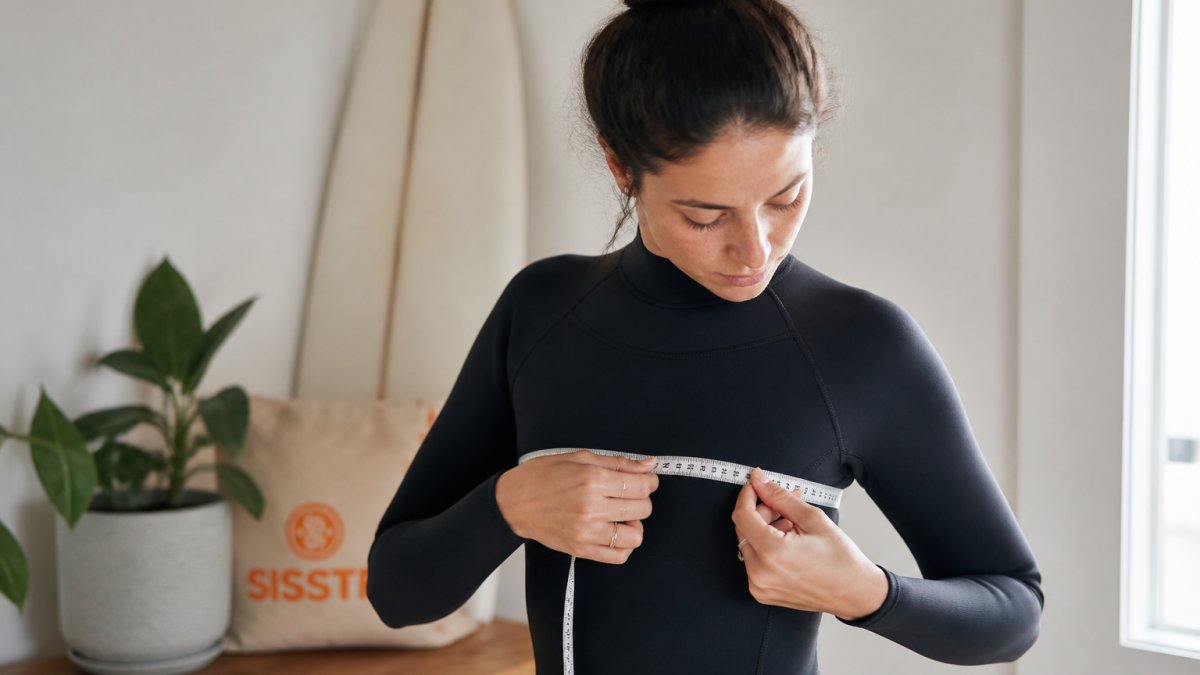
Write these numbers down. Don't round. A half-centimetre matters when you're choosing a women's wetsuit size.
Reading a Women's Wetsuit Size Chart
Most brands use two numbers for their sizing: thickness and fit. The thickness tells you how warm the suit is. The fit tells you if it'll work with your body shape.
Thickness appears as two numbers like 3/2 or 4/3. The first number is the chest thickness in millimetres. The second is the arm and leg thickness. A 3/2 suit keeps you warm in mild water. A 4/3 handles colder conditions.
Fit sizing varies by brand. Some use XS to XL. Others use numbers (0, 2, 4, 6, 8). The Sisstrevolution 7 Seas range, for example, uses numbered sizing.

When you look at a women's wetsuit size chart, match your measurements to the chart's rows. Most charts show chest, waist, and hip ranges for each size. Find the row where your measurements fit best. If your chest is a size 6 but your hips are a size 8, you're between sizes, we'll cover that next.
How Should a Wetsuit Fit on Your Body
A properly fitting women's wetsuit feels almost uncomfortably snug when you're dry. This is correct. The neoprene will stretch slightly once you're in the water and your body warms the suit.
At the chest and shoulders: The suit should sit close to your skin with no more than a finger's width of space. If you can fit your whole hand between the suit and your chest, it's too loose.
At the waist: This is where most women struggle. Your waist should feel held but not restricted. You should be able to take a full breath without the suit cutting into your ribs.
At the neck: The neck seal should sit snugly against your skin without choking you. You should fit one finger under the seal comfortably.
At the wrists and ankles: These should be tight enough that water doesn't rush in, but loose enough that you can feel your pulse. If the seal cuts off your circulation, the suit is too small.
In the shoulders and armpits: This is where fit matters most for movement. Raise your arms overhead. The suit should move with you without bunching or pulling away from your body. If the armhole is too loose, water will flush in constantly.
Once you're in the water, a properly fitting suit will feel like a second skin. Cold water will touch your skin initially, but your body heat warms the thin layer of water trapped between you and the neoprene. That's how wetsuits work.
What to Do if You're Between Wetsuit Sizes
Most women find themselves between sizes at some point. Your chest might be a 6, but your hips are an 8. Or your height falls between two standard lengths.
Go with your chest size first. The chest is where you need the seal to be tight. A loose chest means constant water flushing. A slightly loose hip is annoying but manageable.
If your hips are significantly larger (more than one size up from your chest), consider sizing up. Many women with pear-shaped bodies find that going up one full size gives them better overall comfort than fighting a suit that's tight in the hips.
Sisstr New Seas 3/2 U-Zip Full Suit Wetsuits →
Check the brand's fit notes. Sisstrevolution's sizing guides often note which sizes work best for different body shapes. The 7 Seas 3/2 Chest Full Wetsuit, for example, is designed with an anatomically correct fit that accounts for natural variation in women's bodies.

Try both sizes if possible. If you're ordering online, check the return policy. Many retailers let you try two sizes and return one. Spend 10 minutes in each suit, move your arms, bend, sit down. The right size will feel obvious.
Length matters as much as width. A suit that's too short will ride up when you paddle. Too long, and you'll have excess material bunching at your wrists and ankles. If you're between lengths, go with the longer option.
Tips for Trying On Your Wetsuit at Home
Trying on a women's wetsuit at home is different from trying on regular clothes. You need to test it the way you'll actually use it.
Wear it for at least 10 minutes. Your body heats the neoprene and it relaxes slightly. What feels painfully tight at first might be perfect after a few minutes. If it still feels wrong after 10 minutes, it's the wrong size.
Move like you're in the water. Raise your arms overhead. Rotate your shoulders. Bend forward as if you're paddling. Sit down and pull your knees toward your chest. If the suit restricts any of these movements, it's too small.
Check the seams. Run your fingers along every seam. They should lie flat against your skin. Raised or bunched seams will rub and cause discomfort in the water.
Look for gapping. Have someone take a photo of you from behind with your arms raised. If you see light between the suit and your body at the shoulders, chest, or back, it's too loose.
Feel for pressure points. The suit should feel snug everywhere, but there shouldn't be any spot where it digs in painfully. Pressure points cause bruising and will make you hate wearing the suit.
Don't judge based on how it looks. A properly fitting wetsuit doesn't look flattering. It looks tight. That's the point. It's not fashion, it's function.
Common Sizing Mistakes to Avoid
Choosing based on vanity sizing. If you normally wear a medium in clothes, don't assume you're a medium in wetsuits. Wetsuits use completely different sizing. Measure yourself.
Ignoring the thickness rating. A 3/2 suit won't keep you warm in winter water. A 4/3 will feel restrictive in summer. Match the thickness to your local water temperature and season.
Assuming all brands size the same. They don't. A size 6 from one brand might be completely different from a size 6 from another. Always check the specific brand's size chart.
Buying too loose for comfort. This is the biggest mistake. Women often size up thinking loose will be more comfortable. It won't. Loose means constant flushing and you'll be cold the entire session.
Forgetting about length. Chest size matters, but so does length. A suit that fits your chest perfectly but is two inches too short will ride up and let water in constantly.
Not accounting for body shape. Standard sizing assumes an average body. If you're curvy, athletic, or tall, you might need to size differently. Read customer reviews from people with similar body types.
Returning without trying properly. Give the suit at least 20 minutes of real movement before deciding it's wrong. Wetsuits feel different once your body warms them.
Choosing the right women's wetsuit size means spending more time in the water instead of fighting your gear. Start with accurate measurements, check the brand's size chart carefully, and don't compromise on fit just to avoid ordering twice.
When you find your perfect fit, you'll notice the difference immediately. You'll stay warmer, move more easily, and actually look forward to getting suited up. That's when a wetsuit stops being gear and becomes part of your ocean experience.
The Sisstrevolution 7 Seas range is built with women's bodies in mind. The 3/2 and 4/3 options come in multiple sizes. Once you know your measurements, shop the full range and find the fit that matches your body and your local water conditions. Get in the water and feel the difference a proper fit makes.
Frequently Asked Questions
How do I know if a women's wetsuit is too small?
A wetsuit that's too small will feel restrictive even when wet and warm. You shouldn't be able to pinch more than a centimetre of material between your fingers at the seams or chest. If you feel restricted when paddling or moving your arms, or if there are gaps at the neck, wrists, or ankles, the suit is too small. Proper fit means snug contact with your skin without cutting off circulation.
Should I size up or down in a women's wetsuit?
Size down rather than up. Wetsuits work by trapping a thin layer of water against your skin, which your body then warms. If your suit is too loose, too much cold water flushes through. A snug fit is essential for warmth and performance. If you're between sizes, consider the water temperature you'll be surfing in, opt for the smaller size in cold water, the larger in warmer conditions.
Do women's wetsuit sizes vary between brands?
Yes, sizing does vary between brands. A size 10 in one brand may fit differently from a size 10 in another. This is why measuring yourself and checking the specific brand's size chart is crucial. Always refer to the exact measurements rather than relying on your usual size. Reading reviews from other women with similar body shapes can help you predict fit across different brands.
What should I do if my measurements fall between wetsuit sizes?
If you're between sizes, consider your primary use. For cold water (below 13°C), choose the smaller size for better insulation and fit. For warmer water (above 18°C), the larger size offers more comfort and freedom of movement. Reading customer reviews mentioning similar body types helps predict whether a size runs small or large.